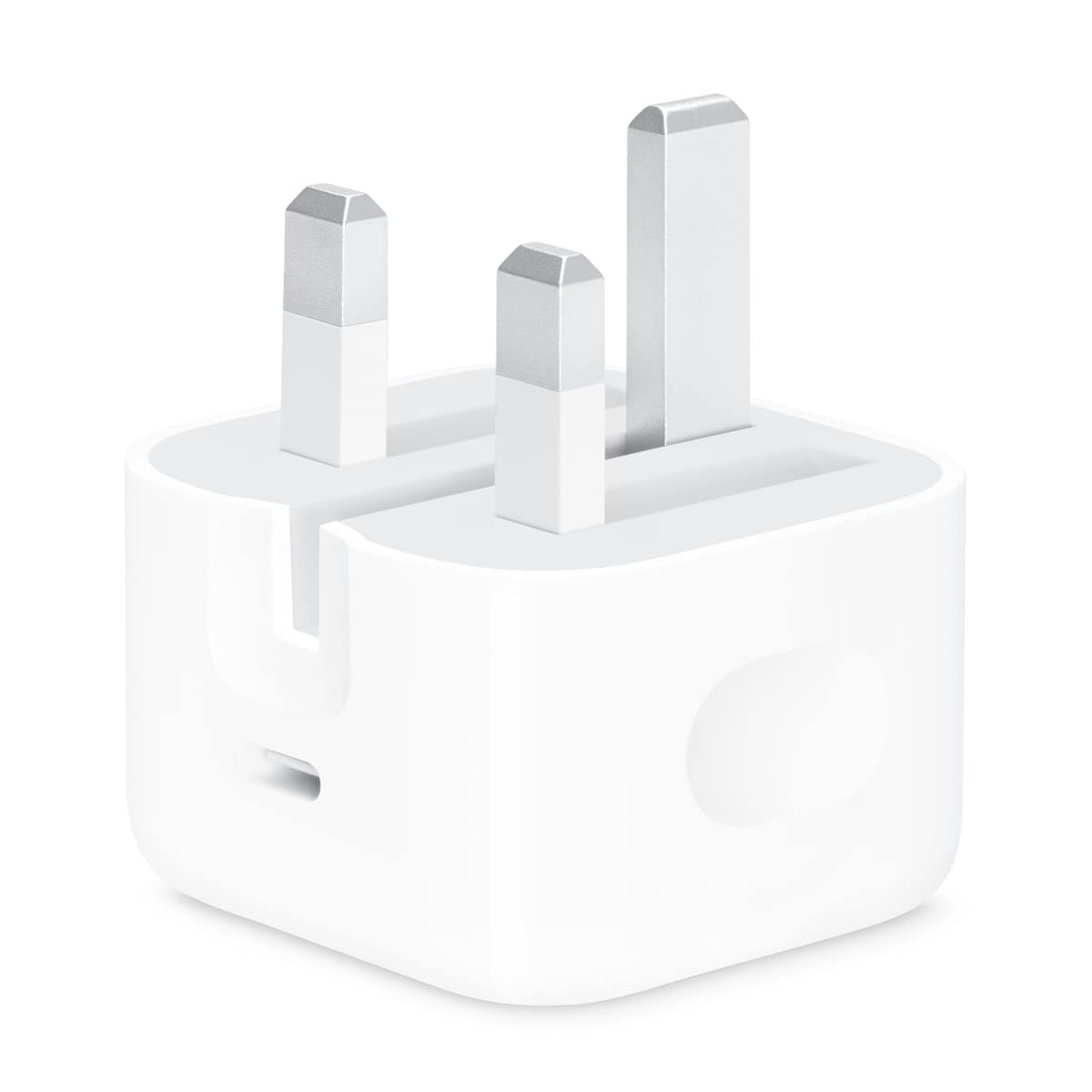

Every week customers ask us the same question at DuuD Telecom: “Is this Apple charger really original?” In one of our DuuD CONNECT tech tips (in Malayalam, embedded below) we put a genuine Apple charger next to a counterfeit one, compared them the way an authorised dealer would, and then opened the fake to see what is inside. This report brings those findings together in English, along with a practical guide to choosing the right wattage for your iPhone or Samsung phone in the UAE.
Why fake Apple chargers look so real
The first thing the video shows is how convincing counterfeits have become. Both chargers on the table carry the Apple logo and are sold as “original”. The printed markings on the body, including details such as the TDR text, look the same on both. Even the weight feels right in the hand. For an ordinary customer, telling the fake from the real one by eye alone is genuinely hard, which is exactly why so many copies end up being sold as genuine.
Weight is a trick many people rely on: “a heavy charger must be real”. As we found out, counterfeiters know this too.
How an authorised dealer spots a fake
To get a reliable answer, we took the chargers to an authorised dealer. Their staff did not need special equipment; they checked the charger much like an experienced cashier checks a suspicious banknote, by feel and by looking at the small details. The differences they pointed out were:
- Packaging glue – the glue and sealing on the original box is neat and consistent; on the fake it is rougher.
- Plastic quality – the original body has a smoother, more consistent finish and feel.
- Paper and booklet print – the leaflet and box printing on the original is sharper and of better quality.
- Finishing precision – edges, seams and joins on the genuine charger are more precise.
- Fit of parts – on the fake, some parts do not sit or close the same way as on the original.
None of these differences is dramatic on its own. Originals differ in many small details, and it takes someone who handles genuine stock every day to notice them together. That is the key lesson: it is not realistic to expect customers to become counterfeit experts.
What we found inside a fake Apple charger
We then opened the counterfeit. Instead of being filled with proper charging electronics, a large part of the inside was packed with clay, and iron pieces were also used, simply to bring the weight up to match a real Apple charger. In other words, the “it feels heavy, so it is genuine” test is exactly what the fake was designed to beat.
A charger that carries mains power into a phone you hold, sleep next to and carry in your pocket should never be built this way.
Watch the video
DuuD CONNECT, September 2024 – in Malayalam.
The price tells a story
At the time the video was recorded, cheap fakes were available at wholesale for a tiny fraction of the cost of the real thing, while genuine Apple chargers were trading at around AED 60–70 wholesale in the UAE market. When a “brand new original Apple charger” is offered far below what genuine stock costs even at wholesale, that alone is a strong warning sign. (These figures are context from the video, not our current retail prices.)
Fake versus branded alternative: not the same thing
The video makes an important distinction. A counterfeit is a product pretending to be Apple, with an Apple logo it has no right to carry. A reputable third-party brand such as Anker is something different: it is openly sold under its own name and backed by that brand. Our advice is simple: never use a counterfeit Apple-logo charger on your phone. If you do not want an Apple adapter, choose a reputable named brand, not a copy.
20W, 40W, 25W, 45W or 65W: which charger do you need?
- Apple 20W USB-C – the standard fast charger for iPhone, the model featured in our video. It takes a recent iPhone to around 50% in about 30 minutes.
- Apple 40W Dynamic Power Adapter – higher-output USB-C for newer iPhones that support faster charging, and handy for iPad.
- Samsung 25W – Super Fast Charging for most Galaxy A and S phones.
- Samsung 45W – Super Fast Charging 2.0 for compatible Galaxy models such as the Ultra and some Plus phones; it charges 25W phones safely at their own maximum.
- Samsung 65W Trio – three ports to charge a phone, earbuds and a tablet or laptop from one plug.
A higher-watt original charger will not harm a phone that supports less power; the phone only draws what it can handle.
Original chargers at DuuD Telecom
All our adapters are original, UAE version stock with a 1-year warranty from activation:
- Apple 20W USB-C Power Adapter
- Apple 40W Dynamic Power Adapter USB-C
- Samsung 25W Power Adapter EP-T2510 (Black) / White
- Samsung 45W Power Adapter EP-T4511
- Samsung 45W Power Adapter with Type-C Cable
- Samsung 65W Power Adapter Trio
What Apple says about checking a power adapter
Apple’s own support pages are clear: genuine Apple USB power adapters are sold by Apple and authorized Apple resellers, and they are built to meet government safety standards. Apple also warns that adapters which do not meet applicable safety standards can be dangerous. Here is the practical checklist taken from Apple Support (not a serial-number lookup — Apple does not offer a public authenticity checker for USB power adapters the way some people expect).
- Buy from Apple or an authorized reseller. That is the strongest authenticity signal Apple and Apple Support Communities give for adapters. Counterfeits often copy logos and markings well enough that photos or serials alone are not reliable.
- Read the certification label on the adapter. Apple says you can identify a USB power adapter from Apple and check its power by looking at the certification label on the brick, which lists the wattage (W). Apple USB power adapters are designed for mains power rated 100V–240V AC at 50Hz–60Hz (so they work on UAE 230V sockets with the correct plug type).
- Look for proper safety certification markings. Apple states that its USB power adapters are certified to standards such as IEC/UL 60950-1 أو IEC 62368-1 (Safety of Information Technology / Audio/Video and ICT equipment). Messy print, missing marks, or odd labels are a red flag when you compare side by side with a known genuine unit — which matches what we show in our video.
- If you have a Mac, check AC Charger Information. Connect the adapter (with a suitable USB-C charge cable), then hold Option and open Apple menu → System Information → Power. Under AC Charger Information you can see the reported wattage. Genuine Apple Watch chargers, for example, list Apple Inc. as manufacturer in System Report; for phone bricks, the label + trusted seller remain the main checks.
- Third-party is fine only if it is a real brand that meets safety standards. Apple says you may use “Made for iPhone” / MFi or other third-party cables and adapters that comply with applicable regulations and safety standards, or a Mac USB-C Power Adapter. That is different from a no-name brick with an Apple logo. For Lightning cables and many accessories, Apple’s guide is to look for the MFi / Made for badge on packaging — see Apple’s page on counterfeit Lightning accessories.
Primary Apple references:
- About Apple USB power adapters — how Apple identifies its USB adapters, certifications, and safe replacement options
- Use a power adapter with your Mac — reading wattage from the certification label and from System Information
- Identify counterfeit or uncertified Lightning connector accessories — packaging, MFi badge, and connector details for cables
Where to buy safely in the UAE
The safest path, as the video concludes, is to buy from a trusted or authorised seller you know. Shop the full range in our Chargers and Cables category, or visit our shops in Dubai and Ajman to see the product in person. We deliver across the UAE, usually within 1–2 working days, and delivery is free on selected products – see الشحن والتوصيل for details.
FAQ
Can I tell a fake Apple charger by its weight?
No. The fake we opened was filled with clay and iron pieces specifically to match the weight of a genuine charger.
Do the logo and printed markings prove it is original?
No. In our comparison the Apple logo and markings such as TDR looked the same on both. Small details like glue, plastic, print quality and finishing are what differ.
Is an Anker charger a fake?
No. Anker is a reputable brand selling under its own name. A fake is a product that copies the Apple logo.
Which charger should I buy for my iPhone?
The Apple 20W USB-C adapter suits most iPhones; the 40W Dynamic Power Adapter suits newer models that support faster charging.
What warranty do DuuD chargers have?
Our original, UAE version chargers carry a 1-year warranty from activation.
The bottom line
Your phone is the gadget that stays closest to you all day. Do not shorten its life, or take risks with your safety, to save a little on a fake charger. Buy original from a seller you trust – shop Chargers and Cables at DuuD Telecom.